How Sitting For Long Hours Kills You Slowly As A Remote and Office Worker
- Oct 29, 2025
- 5 min read
Life feels unscripted yet scripted. The culture of work is fast evolving and as a remote worker there is now a thin line between work-life balance. Let’s have a run through a typical working day for most freelancers and remote workers, you wake up, switch on your your laptop, reply mails, attend virtual meetings and spend time working on your computer trying to meet de
adlines. And before you know it, eight hours have passed, just like that, and you haven’t stood up once.
I know how you feel. That’s my reality too and being intentional and strategizing is how you can prioritize your health despite maintaining a sedentary position. The sedentary position is not your enemy your inaction is. A 2013 report by The World Health Organization (WHO), projects that 3.2 million people worldwide die prematurely each year due to a sedentary lifestyle. Further studies have also found that individuals who maintain sustained sitting positions for prolonged hours have a 1.4 times greater chance of dying prematurely after 12 years when compared to their counterparts who sit for less time at work.

Maintaining static positions like sitting for prolonged periods is like being born without a silver spoon which means by projection life would be difficult. However, the chances of living a good life can further reduce if I start borrowing money and all I do is smoking and drinking without investment or future plan. I don’t need a seer or prophet to tell me I would live life in penury. That’s exactly how working from a poor ergonomic workstation can aggravates the effect of prolonged sitting and damage your body.
Adopting a good working habit where you can break your sustained sitting cycle at work is all that matters in maintaining your overall wellbeing at work. However as a curious being, you have to understand what the dangers of sitting for prolonged periods are to drive a change. Follow me closely as I tell you what prolonged sitting really does to your body.
Just before I proceed let me do a bit of myth-busting. Take some time to reflect on both sitting and standing positions. Choose an answer in your mind on which is a good or bad position?
Which posture do you think is better for your health?
Sitting
Standing
Both
Here is the clinical fact, no position is good or bad. What makes a position bad and detrimental to your health is how static it is and how long you have been assuming that position for. Prolonged sitting and standing have been clinically linked to musculoskeletal disorders and cardiovascular problems. I just had to digress a bit to compare these positions so you are not running with half-baked truth. This post is focused on sitting and that’s because DSE users such as remote workers and freelancers are trapped in this web.
Here's what your body could be experiencing when you sit for prolonged periods;
1. Musculoskeletal Disorders (MSDs)
This is a clinical term which is used to describe broad conditions like that affect your muscles, joints, ligaments, tendons, and nerves. This is also the leading cause of disability globally.

Now let me make this more relatable, most remote workers often complain about lower back pain, neck pain, shoulder tension, wrist pain, tight hips and stiff knees which are mostly associated with maintaining prolonged sitting postures or working from a work station with poor ergonomic support. Prolonged sitting and poor workstation make your muscles, joints and tendons expend more energy to assume sitting position and this results to fatigue and pain.
2. Reduced Circulation
It is a known clinical fact that the heart is the primary organ for circulation. However, with the understanding of anatomy and physiology, your calf muscles also provide support to your cardiovascular system to aid venous return back to the heart.

I know the question on your mind is what does this have to do with sitting? When you sit, the blood vessels in the legs are compressed, pressure builds up in your vein as your calf muscles are not active and this can lead to poor circulation. If this happens over a long period, it can result in varicose vein. What you then experience is that you feel exhaustion in your leg, cramps, swelling and pain, even when you haven’t done anything physically demanding.
3. Nerve Compression
Nerve pain is characterised by numbness, weakness, and tingling sensations. Nerves around your spine can get pinched due to the compression and pressure build up in your back as a result of sustained sitting.

This is how conditions like cervical radiculopathy, piriformis syndrome and sciatic nerve pain develop. These problems don’t always start with serious back or neck pain. They start with mild pain and weakness but if left untreated can cause irreversible damage and reduce quality of life.
Why do people struggle with the sitting?
Let’s be sincere. Being a remote worker especially in Nigeria comes with specific realities that make healthy movement harder. Here are some reasons for this.
1.Heavy workload/Busy schedule
It's a Wednesday morning, you check your schedule and you know it's going to be a very busy day. You have to complete your assigned task by 3:15 p.m. Luckily, you are very good at what you do, so, you run about 3-4 different jobs and you have so many deadlines to meet. Let's say NEPA now “shenked” you, so, you turn on your generator and want to rush through work before the fuel finishes.

Let me guess, the question in your mind is “How do you expect me to be moving around with all of these?”
2. Low awareness of long-term risk
Maybe you are even in the category of people that are not aware that sitting for long without any movement can be very risky. You feel that back pain, but then, you think it’s not that deep.


Yet, that back pain is a warning. And untreated MSDs can lead to long-term disability, reduced productivity and irreversible joint damage.
What you can do now without disrupting your workflow
To answer your question about how you can move around even with a busy schedule, here are realistic, safe and friendly ways to add movement without overhauling your day.
1. Optimize your workstation to provide ergonomic comfort


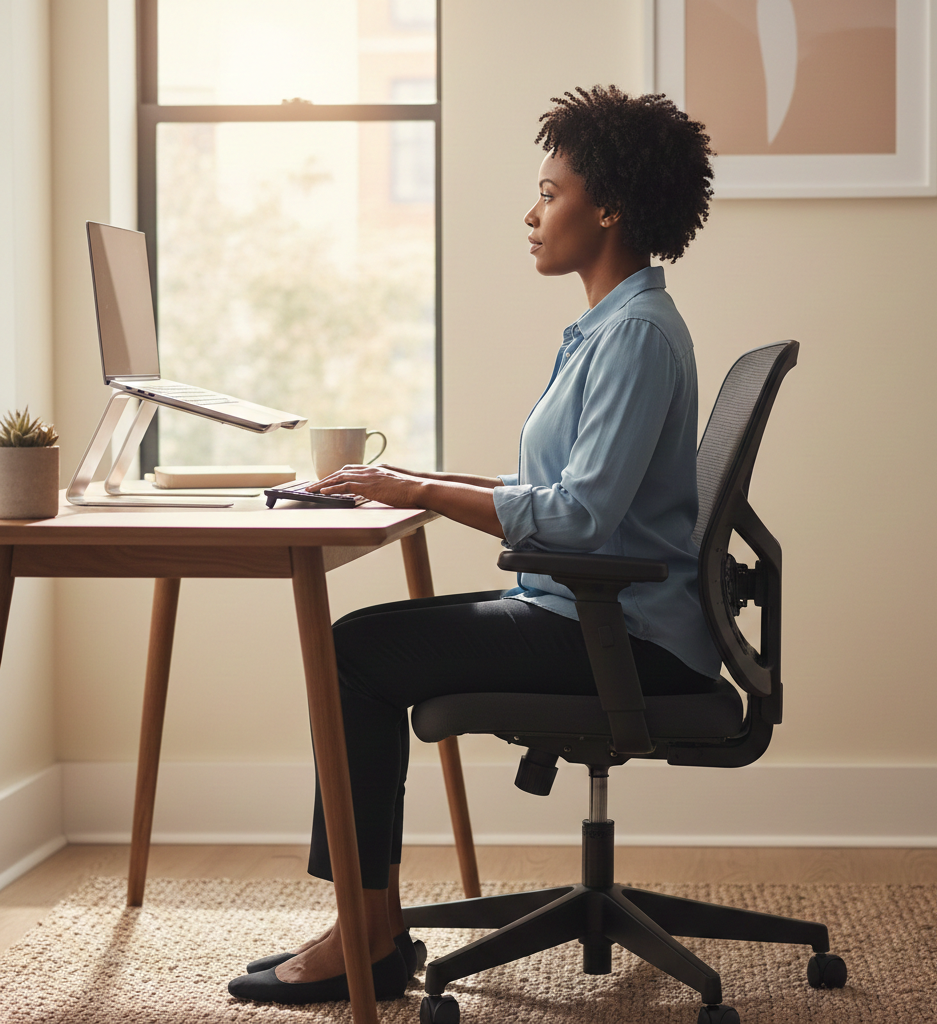
Ergonomic Workstation/Unsplash
Imagine sitting for like 6 hours on a stool or plastic chair, without movement. That's a lot.
If you can't afford ergonomic chairs or an adjustable desk at the moment, you can still improve your ergonomic comfort, till you get one. Use a throw pillow behind your lower back for lumbar support, and keep your feet flat on the floor or a box.
2. Make movement part of your daily life
I know you have deadlines, but your health matters. Here's what you can do. Set alarms for every time you finish a task. Stand up and walk around for about 2-3 minutes. While waiting for that page to load, you can do gentle stretches, walk around during your meetings. You can do it without being distracted, by pacing. You don't need to take 23,000 steps.


Hear me out, you can even listen to a song you like and dance for a few minutes. Dancing is a form of movement too.
Don’t wait for that musculoskeletal discomfort to become pain, and then become permanent. Break the sitting cycle before it breaks you. And if you're already experiencing any form of musculoskeletal pain, speak to your doctor or see a physiotherapist as soon as possible. Don't delay it. Delay might be very dangerous.


Comments